


When a 3PL manages your inventory, it takes over five connected jobs:
- Tracking every unit in real time, down to lot and expiry level where needed
- Positioning stock in the right location
- Syncing stock across every sales channel to prevent overselling
- Running order management so live stock never gets sold twice
- Applying data-driven methods, like ABC analysis and reorder point formulas, to keep the right amount of product on hand
A modern 3PL runs all of this through a single technology platform, replacing spreadsheets and manual counts with automated, real-time visibility.
What does inventory management with a 3PL actually cover?
Inventory management with a 3PL is the process of tracking, positioning, and optimising your stock across your 3PL’s fulfilment network, so that stock levels stay accurate, product sits in the right locations, and orders never get placed against inventory that isn’t there.
Rather than you tracking stock in a spreadsheet and manually chasing reorders, the 3PL takes on the operational work of tracking, positioning, and reordering stock, while giving you real-time visibility of everything happening to it.
A 3PL relationship changes who does the day-to-day work of inventory management, but not what that work is trying to achieve: less storage cost, less wastage, and stock always available when a customer wants to buy. The difference is that a 3PL brings dedicated technology, warehouse processes, and data analysis to the job, at a scale most brands can’t build in-house.
How does a 3PL track inventory in real time?
A 3PL tracks inventory using barcode scanning, logging every inflow, outflow, and stock movement into a centralised platform the moment it happens. This real-time tracking is the foundation everything else in inventory management depends on. Without it, orders get placed against stock that isn’t there, reorders happen too late, and costs become unpredictable.
The difference this makes is less about the technology and more about the timing. A daily or weekly stock count tells you what your inventory looked like at the last check, not what it looks like now, which means every decision made in between (what to reorder, what to promise a customer at checkout, whether a SKU needs attention) is being made on data that’s already out of date.
Real-time tracking closes that gap, so stock levels, reorder triggers, and customer-facing availability all reflect what’s actually on the shelf at that moment, not what was there this morning.
Do 3PLs track lot numbers and expiry dates?
For categories like cosmetics, health and supplements, and food and drink, tracking goes beyond SKU and quantity. A capable 3PL also logs batch or lot numbers and expiry dates at goods-in, and enforces FEFO (First Expired, First Out) picking, so the oldest eligible stock is always the stock that ships.
This matters most for brands in expiry-sensitive sectors, where shipping the wrong batch can mean a product reaching a customer closer to its expiry date than it should.
Good batch control means being able to act on batch data. We helped übbs meet their B2B partners’ minimum nine-month shelf-life requirement by overriding standard FEFO rotation using batch data.

How is inventory accuracy maintained day to day?
Real-time tracking reduces errors, but it doesn’t eliminate them entirely. A well-run 3PL runs regular cycle counts, physically checking a rolling sample of stock against system records, to catch and correct discrepancies before they affect a live order.
This is the mechanism that keeps a system’s real-time count trustworthy over time, rather than assuming automation alone is sufficient.
Where does a 3PL store your stock?
A 3PL positions stock based on sales velocity, product size, and destination demand, placing fast-moving SKUs closer to packing areas and, for multi-location networks, stocking product closer to where customers actually are. Good positioning is what turns inventory into faster, cheaper delivery, rather than just safely stored stock.
Inside a single fulfilment centre, this means fast-moving SKUs sit close to the packing area to cut walk time, while slower movers are stored further back. Across a network of fulfilment centres, it means holding stock in the regions where demand actually exists, rather than shipping every order from one central location.
Example: positioning stock closer to demand
Dr. Squatch had built a hugely successful personal care brand in the US, but shipping every international order from a single US warehouse was holding their global ambitions back. Customers in the UK, Europe, and Australia were waiting anywhere from 7 to 28 days for their orders to arrive, a tough ask when you’re trying to win over customers in a new market.
Once J&J set Dr. Squatch up with fulfilment centres in the UK, the Netherlands, and Australia, much closer to where those customers actually live, delivery times dropped to just 1 to 5 days. International customers now receive their orders 88% faster on average, and the brand has seen a real lift in customer retention and subscription sign-ups since making the move. (Source: J&J Dr. Squatch case study)
Dr. Squatch set their eyes on the international market.
Read the case studyWhat happens when an order comes in against live stock?
A 3PL’s order management system checks live stock levels the instant an order comes in, preventing orders from being accepted for items that are actually out of stock, and automatically pushing status updates back to the customer. This is the layer that connects your storefront to the warehouse floor, so what your customer sees online matches what’s actually sitting on the shelf.
Order management also supports the fulfilment process more broadly, from facilitating secure payment confirmation through to feeding the returns process once a customer sends something back. A well-run system reduces disappointment by keeping customers informed of order status automatically, rather than leaving your team to chase updates manually.
Can a 3PL prevent overselling across multiple sales channels?
A 3PL prevents overselling by syncing available stock across every connected sales channel in real time, so the moment a unit is picked and packed on one channel, the available count drops everywhere else automatically. Without this sync, a single pool of stock can get sold more than once across different storefronts, which leads to cancellations and, on some marketplaces, account-level penalties.
This matters most for multi-channel sellers running Shopify, Amazon, TikTok Shop, and wholesale from a single stock pool. A platform that only updates stock levels periodically, rather than in real time, creates a window where a channel can still show an item as available after it’s actually sold out elsewhere. Direct, live integrations with each platform are what close that window.
What’s the difference between a 3PL’s inventory platform and a general WMS?
A warehouse management system (WMS) tracks inventory inside the four walls of a warehouse: what’s on a shelf, what’s been picked, what’s ready to ship. A 3PL’s inventory platform typically goes further, managing order orchestration, multi-channel sync, carrier selection, and client-facing reporting from the same place, rather than treating the warehouse as a system on its own.
The distinction matters when evaluating providers. A 3PL running a WMS underneath a separate reporting layer, bolted on to give clients visibility, will usually give you a less unified view than one built on a single platform end to end. In practice, this shows up as a gap between what the warehouse floor knows and what your dashboard shows: stock might be accurately tracked internally, but the update reaching your storefront or client portal lags behind it. A platform designed as a single system from the outset closes that gap, since the same data powers both the warehouse operation and what you see.
What inventory management methods does a 3PL apply? (safety stock row)
A 3PL typically draws on a combination of established inventory methods, chosen to fit the brand’s demand pattern, rather than applying a single rigid model to every SKU. These methods aren’t mutually exclusive: a 3PL will often apply different ones to different parts of your catalogue depending on how each SKU behaves.
| Method | What it does | Best suited to |
|---|---|---|
| Just-in-Time (JIT) | Keeps the optimal amount of stock in the right place at the right time, minimising storage | Predictable demand, lower risk of sudden spikes |
| Economic Order Quantity (EOQ) | A formula-based model calculating the optimal reorder quantity from historical data | Brands comfortable basing decisions on historical patterns |
| ABC Analysis | Classifies SKUs by sales impact (Class A, B, C) to prioritise restocking effort | Catalogues with a wide spread of fast and slow movers |
| Days of Sale Inventory (DSI) | Measures the average days it takes to turn stock into a sale | Monitoring overall inventory health and cash tied up in stock |
| Safety stock | A buffer held above forecasted demand to absorb unexpected spikes or supplier delays | Categories with variable demand or less predictable lead times |
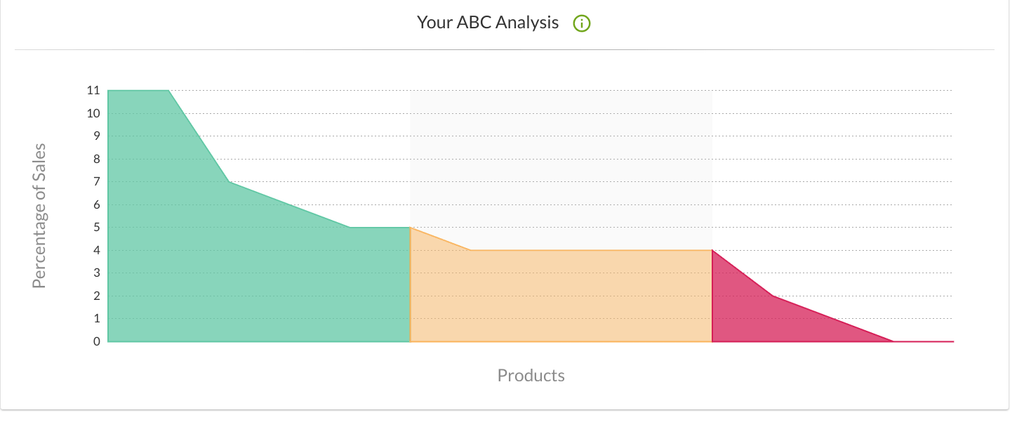
Under ABC Analysis specifically, Class A SKUs are the fast movers that drive the bulk of turnover and need reliable restocking plans to avoid stockouts. Class B SKUs hold intermediate importance and are usually covered with buffer stock. Class C SKUs move slowly and are reviewed regularly to check whether they’re still worth the storage space they occupy.
A 3PL can also apply the Economic Order Quantity formula to individual SKUs where reorder timing needs to be precise, rather than left to a general rule of thumb.
Example: ABC analysis inside ControlPort™
Rather than calculating this manually, J&J’s ControlPort™ includes an ABC Analysis Graph that classifies every SKU by cost and quantity automatically, colour-coding each one green, amber, or red for Class A, B, and C. At a glance, that shows which lines can never go out of stock, which need a buffer, and which are worth reviewing to check they still justify their shelf space.
What role does automation play in 3PL inventory management?
Automation replaces manual counting and spreadsheet tracking with real-time, system-driven processes: automatic reorder point triggers, automated parcel sorting, and live multi-location stock visibility, all feeding a single source of truth. The result is fewer human errors, faster processing, and a system that scales with order volume rather than requiring proportionally more staff as you grow.
Automated purchase order generation works by setting a reorder point based on historical sales data, so the system prompts a restock before stock actually runs out, rather than after. Automated parcel sorters increase the volume of orders a warehouse can process without adding headcount. Warehouse management technology maintains optimal stock levels across multiple locations by giving real-time visibility into what’s on hand at each one, which supports both demand forecasting and day-to-day picking accuracy.
What should you expect from a 3PL’s inventory technology and reporting?
You should expect a single platform giving live stock visibility, automated alerts, and historical data you can use to spot trends, rather than a report your account manager compiles manually and emails you. The quality of a 3PL’s technology has a direct effect on how much genuine control you retain once you’ve handed over the physical operation.
A capable platform, such as J&J’s ControlPort™ platform, should give you the same real-time data the 3PL’s own operations team works from, covering inventory, orders, and reporting from a single place, live. Our 3PL inventory technology and reporting is built around exactly this: real-time visibility, live reporting, and client portal access from day one.
Checklist: what to verify about a 3PL’s inventory management before signing
- Confirm stock is booked into the system and available for orders within a stated turnaround, ideally 24 hours from goods-in.
- Ask what reorder point or forecasting logic the platform uses, and whether it’s automated or manual.
- Ask whether the platform supports multi-location stock visibility if you sell internationally.
- Check whether historical inventory data, trends and not just point-in-time snapshots, is accessible to you directly.
- Ask how pick and pack accuracy is measured, and what the current figure is.
- Confirm whether ABC-style SKU classification, or an equivalent, is used to prioritise restocking.
- Ask how stock levels sync across your sales channels, and how quickly, to confirm oversell risk is genuinely covered.
- If you sell expiry-sensitive products, confirm lot or batch tracking and FEFO picking are supported as standard.
- Ask how often cycle counts are run and how discrepancies are reported back to you.
Our OMS, ControlPort™, gives clients access to SLA performance, inventory reports, batch tracking, ABC analysis and more, all synced in real-time across our fulfilment centres.

Inventory management is one part of a full 3PL service
Everything covered here – tracking, positioning, order management, and the technology behind it – is one part of what a 3PL delivers. Our Third-Party Logistics (3PL) guide brings all of it together alongside pricing, onboarding, and provider selection, for brands ready to hand over the full operation rather than just the inventory piece.
Frequently asked questions
Yes. The stock itself remains your property throughout the relationship, and a good 3PL gives you direct, live access to the underlying data your decisions depend on, rather than treating it as something you have to request from an account manager.
Yes. A 3PL with a multi-location network can route individual orders to the fulfilment centre closest to the customer and rebalance stock across locations based on demand, which reduces both shipping cost and delivery time.
No, not as a separate system of record. The 3PL’s platform becomes your inventory system for the stock they hold, and you access it directly rather than maintaining a parallel spreadsheet or tool. Some brands keep lightweight internal reporting on top for their own analysis, but that sits alongside the 3PL’s platform rather than duplicating its core function.
Automated systems significantly reduce the frequency of stock discrepancies compared with manual counting, but no system is entirely free of error. A well-run 3PL will have reconciliation processes and cycle counts in place specifically to catch and correct these discrepancies before they affect an order.
